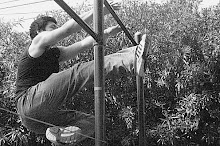
For my third practicum I chose to do something similar to Josie's first one, paying special attention to the little things in my life. I've been noticing these little details more and more as the year's gone on, which was a really eye-opening experience for me when I noticed the level of awareness I had attained. While the actual week that I set aside for this practicum wasn't as strong as it could've been, I've had this heightened awareness for long enough to get the insight of a practicum.
I first started noticing this around when I started working on the play this year. There was a great “Aha!” moment when I was watching Murren do a scene and noticing how alive his character was; I looked for what he was doing to be so convincing, and it came down to details: micro-expressions, inflection, etc., the details were what made his character so convincing. Though I can't speak very well to acting, this seems to be the same as life in general: the details make the experience worthwhile. I do believe that grand things are also important and cool, but I appreciate the littler things more. This isn't only limited to people though, it includes things as seemingly mundane as the smell of rain, feeling a concrete wall with my hand, tasting plain bread, hearing my own footsteps, seeing a street lamp go out. I believe that these are what life is all about, the richness and detail that abounds in the world that are always at our fingertips.
In addition to this, which by itself is profound, I believe that the smallest of details are what change the world. The saying of with the butterfly flapping it's wings in China and eventually leading to a tornado in Kansas holds a lot of meaning to me. The smallest of actions can have huge effects far down the chain of events, and since there are so many things that could've affected something, there's often a hidden explanation to everything, even if we can't know it. I believe this connection is the same one talked of in the Tao Te Ching, everything influences everything else. Knowing this is a component of wisdom: to recognize that my own actions are both depend on and affect other people.
Noticing and placing importance on the little things is my internal way of balancing-out the world. As many of you know, I am easily amused by things, and am often not terribly bothered by major stuff, which is an invaluable quality for me. No matter what my situation, I place a similar importance on that. This does have it's limits, though, and I tend to be overwhelmed by highly-detailed projects. I value this as well, my ability to extract fine details about how my mind processes thought. While this isn't really a core value per se, I place tremendous value in gaining this knowledge about myself.
5.03.2009

4.12.2009
Text Study 3: The Tao, Revisited
For my third text study, I chose to revisit the Tao Te Ching, using it to refine my beliefs further. I chose three common themes in the Tao that specifically resonated with me: being content with how life is, living a consistent life, and deprecation of humanity's blind quest for knowledge. These have begun to play a larger role in my life, especially over the past few months, and I strongly feel that these are at the core of how I want to lead my life.
1. What stories or metaphors does the text use that illustrate or challenge your values and beliefs?
The metaphor that leaps out for me is in chapter 13 of the Tao:
This speaks directly to my value of living a consistent life. Sure, I do want some things to change, but what this passage means to me is that I should be wary when I desire to make a change, because transition brings with it an element of vulnerability. To be honest, I do not desire the prototypical view of a successful life, just to find a place of contentment and reside there. When I achieve that, I will be happy as a clam.
2. What "hard questions" does the text ask or answer about your values and beliefs?
Throughout my life, I often worry or fret about things. Though it can be a good thing sometimes, I usually would worry to the point of not being able to think of anything else. The "hard question" for me is a conflict between my deep value of being content with life and what seems to be an intrinsic worried state that I will fall into. I am not sure how this will be resolved just yet, as it is such a huge conflict for me.
3. How were you reinforced in you values and beliefs, or how did your understanding of them change as a result of studying this text?
There is such great similarity between my beliefs and the text, the best way to illustrate this is to let Lau Tzu do the talking:
4. What are your core values? What do you believe?
I believe in living a grounded life,
in staying to what really matters,
in preserving mystery.
I value calm,
humility,
presence,
wisdom.
1. What stories or metaphors does the text use that illustrate or challenge your values and beliefs?
The metaphor that leaps out for me is in chapter 13 of the Tao:
Whether you go up the ladder or down it,
your position is shaky.
When you stand with your two feet on the ground,
you will always keep your balance.
This speaks directly to my value of living a consistent life. Sure, I do want some things to change, but what this passage means to me is that I should be wary when I desire to make a change, because transition brings with it an element of vulnerability. To be honest, I do not desire the prototypical view of a successful life, just to find a place of contentment and reside there. When I achieve that, I will be happy as a clam.
2. What "hard questions" does the text ask or answer about your values and beliefs?
Throughout my life, I often worry or fret about things. Though it can be a good thing sometimes, I usually would worry to the point of not being able to think of anything else. The "hard question" for me is a conflict between my deep value of being content with life and what seems to be an intrinsic worried state that I will fall into. I am not sure how this will be resolved just yet, as it is such a huge conflict for me.
3. How were you reinforced in you values and beliefs, or how did your understanding of them change as a result of studying this text?
There is such great similarity between my beliefs and the text, the best way to illustrate this is to let Lau Tzu do the talking:
Free from desire, you realize the mystery.
Caught in desire, you see only the manifestations.
-Chapter 1
Chase after money and security
and your heart will never unclench
-Chapter 9
If you let yourself be blown to and fro,
you lose touch with your root.
If you let restlessness move you,
you lose touch with who you are.
-Chapter 26
Be content with what you have;
rejoice in the way things are.
When you realize there is nothing lacking,
the whole world belongs to you.
-Chapter 44
4. What are your core values? What do you believe?
I believe in living a grounded life,
in staying to what really matters,
in preserving mystery.
I value calm,
humility,
presence,
wisdom.
3.18.2009
Interview 3: Aaron Swartzman
1.What are Aaron's core values? What does he believe?
2.What stories and metaphors does Aaron use to illustrate his values or beliefs?
3.What are the “hard questions” about Aaron's values and beliefs? How does he respond to those questions?
While Aaron is fairly well grounded in his beliefs, there is still some internal conflict involving his beliefs; the more he develops intellectually and refines his beliefs, the more he feels at odds with society. With this he wants to help mold and change society, not necessarily to subscribe to his own beliefs, but for each individual to find their way in the same manner that he did; following their passions. Aaron is starting to figure out how to overcome this, by focusing on what he can control and making the changes in himself, trusting that society will reach that point in the end.
4.How has your perspective on your own beliefs and values changed as a result of the interview?
Before I interviewed Aaron, I asked him to think of three core values that he holds, the three he came to the interview with were curiosity, reflection, and following through. He told me that curiosity and reflection he had held for a long time, at least since high school, and that following through he was just starting to discover as a value of his.
In curiosity Aaron sees a guiding force, something that drives him to try new things and to explore the world in ways that he hadn't thought of before. He is inspired by the world because of his curiosity. Because of Aaron's curiosity, he has gained a vast breadth of knowledge, he feels a sense of wonder at how much he can learn through his curiosity. He feels that curiosity is his natural state of interacting with the world, something that he wants to cultivate in his life.
The second piece of Aaron's underlying values is reflection. For him reflection manifests as giving himself enough time to process his life, to a point where he's able to integrate everything he's curious about into a form; “I want to bring everything together into one system that makes sense.” He finds that he sets aside more time than many of his friends for “doing nothing,” which gives him time to reflect. He also sees reflection in a more mundane way, as a means of being considerate to others.
The value of following through is something that is relatively new to Aaron, and is something that he is currently trying to use to structure his life. It works on both the physical aspects of his life and the more reflective ones. In dance, he believes in following through with the movement and letting it resolve. In improvisation, following thorough is very important, taking an idea and not dropping it until it reaches it's natural conclusion. Following through provides a practical application for turning curiosity and reflection into action in the world.
2.What stories and metaphors does Aaron use to illustrate his values or beliefs?
A metaphor that Aaron kept coming back to was that of symbiosis, two things coming together and helping each other out. A great example of this is of the symbiotic relationship between curiosity and reflection. Curiosity is a value that drives him ahead and gives him a great deal of energy and speed in his life. On the other side, reflection is pulling him up short, making sure that his ideas and experiences have time to become more cohesive and less chaotic.
The story that he told that most stuck out for me was one of when he was in high school. He had an assignment to choose a character that had three values that Aaron believed in; he chose Peter Duck, a fictional character in a book. Two of Peter's values were wisdom and curiosity, from which Aaron decided that curiosity was more important to him. His teacher asked him why he didn't choose wisdom, for wasn't that surely the more desirable? He replied that no, curiosity was far more important than wisdom, because it is so much more difficult to regain true curiosity once it is lost, and wisdom is hard to attain without curiosity.
3.What are the “hard questions” about Aaron's values and beliefs? How does he respond to those questions?
While Aaron is fairly well grounded in his beliefs, there is still some internal conflict involving his beliefs; the more he develops intellectually and refines his beliefs, the more he feels at odds with society. With this he wants to help mold and change society, not necessarily to subscribe to his own beliefs, but for each individual to find their way in the same manner that he did; following their passions. Aaron is starting to figure out how to overcome this, by focusing on what he can control and making the changes in himself, trusting that society will reach that point in the end.
4.How has your perspective on your own beliefs and values changed as a result of the interview?
I found that Aaron and I have many things in common, making for a great interview. One of the most significant ones for me was that we both value taking time to be still and process what is going on in our lives. We also find great value in movement, and find that it completes our lives by playing well off of a different aspect of who we are. We both value in being present, not just physically, but mentally as well. A quote that really stuck with me was “for most humans, speech defines us.” which seems at odds with my value of presence. I believe that while my personal existence is “defined” by my actions and presence, what truly defines humans is what happens behind our actions and words. I'm not sure exactly how to identify this...”spirit”?...behind people, but I think it's an area ripe for further exploration.
3.08.2009
Seconnd Practicum, Week Two
Week Two
For the second week of my practicum, I worked on refining my work with nonviolent communication. I looked through the rest of Nonviolent Communication: The Language of Life, and generally worked on being more compassionate with how I interacted with other people.
What interesting experiences have you had as a result of practicing this belief or value that you could not otherwise have had?
Mostly I noticed a decline in the amount of negatively leaning (violent) conversations that I had with other members of my family. I rarely had cause to argue or bicker with my brothers or my Mom. I'm not sure if this is due to my sudden mastery of nonviolent communication, or if it's just a fluke; but either way, I'm happy that the past week turned out the way it did.
What new insights do you have about the belief or value you're practicing?
This week I feel I got a preview of how my life could change for the better using nonviolent communication, or something similar in nature. Overall, my week was far less stressful and I didn't worry as much as I could've. At the same time, nonviolent communication isn't exactly what I believe in following, at least not all the time.
Is the “higher level” at which you're practicing sustainable in your life? Why or why not?
Not exactly. There are definitely parts of nonviolent communication that feel in keeping with my beliefs, but there are other aspects that don't ring true for me. I will incorporate the aspects of it that I find useful or fulfilling, such as choosing my words carefully when they might be misinterpreted, not intentionally harming somebody's emotions, and responding to the meaning behind what people say, because those things feel like the right thing to do to me. On the other hand, I do not want to take on the responsibility of putting so much effort in every single interaction that I have. I feel that the practice of nonviolent communication can lead to very wordy, unwieldy conversation, which I don't believe is necessary in a more casual context. I do not think that I should anticipate the ways that I could possibly be misinterpreted all the time, and that my established rapport with people that I know will ensure that less serious interactions won't be blown out of proportion.
What are your core values? What do you believe?
I believe that context should dictate how I communicate with other people, and that nonviolent communication is an effective way to handle possibly volatile situations or to allay rising emotional conflict. My core values of respect, non-conflict, and responsibility for how I perceive and experience the world are related directly to this topic.
I'm glad that I took this second week to flesh-out what nonviolent communication means to me, and it has given me new insight into the possibilities for how I can interact with my world.
3.01.2009
Second Practicum: Nonviolent Communication
Week one
For the past week I have been exploring Nonviolent Communication as a means of communicating feelings and information. I read parts of Nonviolent Communication: A Language of Life, and focused on using principles that I found in the book. NVC, as it's commonly referred to, emphasizes listening to the meaning behind a person's words or actions and responding in as compassionate of a way as possible.
During the week that I was doing this practicum, I was ill and only had limited interactions with other people. As a result of this, I will be continuing to explore the principles of NVC for another week and posting an additional (hopefully more insightful) writeup in time for next week's Seminar.
What interesting experiences have you had as a result of practicing this belief or value that you could not otherwise have had?
Over this past week, I had the interesting experience of interacting with other people from an entirely different perspective than I previously had. A notable one is a conversation I had with Andrew Speed the morning that I started my practicum; we were sitting on the couch, and he indicated frustration that the computers weren't available before check-in. Normally I would brush him off or say something about my opinions on computer use at school. However, this time I noticed that he wasn't all that interested in discussing it, instead he wanted to have his opinion heard. So I listened to him talk about the computers for a few minutes, and made sure he knew that I had heard what he wanted to say. Afterwards we went about our business, though I noticed him engaging me further on other things he was doing, which is different from what had been our normal rapport.What new insights do you have about the belief or value you're practicing?
Words can be a very powerful form of interacting with another person, and they can be used for many good and worthy purposes. However, even though words can be used for such great good, they must be used with caution, they are equally effective tools for fostering healthy relationships and tearing down the bonds that hold people together. Words are also not the most effective way of conveying deeply felt feelings or desires. Words can lead to a great many actions, which is one of the great uses for them, in my opinion. I still strongly believe that actions boom far louder than any words, no matter how loudly they are shouted.Is the “higher level” at which you're practicing sustainable in your life? Why or why not?
In this past week it has been my experience and belief that NVC is extraordinarily difficult for me to cultivate in myself, to the extent that is described in A language of life. That being said, I do believe that I am capable of being cautious with my words, and put that awareness into action when I feel the situation requires it.What are your core values? What do you believe?
I believe that words should be approached with great caution, as they can be harmful if not used in a responsible manner. I believe that words can be a great force for good and the strengthening of relationships with other people. I also believe that words can be illusionary. Naming a particular emotion or feeling with a word can give the misconception of sympathy for the reader. I believe that there is no way for somebody to fully understand what another person is truly feeling, and while words can be a wonderful tool to help aid in getting closer to that, we can only see the reflection of that person's true state of being.2.10.2009
First Senior Essay: Parkour Philosophy
Parkour is often thought of as an entirely physical practice: “jumping over stuff.” However, Parkour is more an exercise of the mind than the body. The most obvious sign that I am a traceur is, of course, how I move. A true practitioner understands that this isn’t the most important part of being a traceur, however. Parkour has an underlying philosophy, a core that gives me an inner strength for any situation I may come across. Incorporating this philosophy into my very being, so that it becomes something as natural as breathing, is what I continue to work towards, what every traceur works towards, as the ultimate achievement in Parkour.
Parkour’s philosophy is often described as “to overcome obstacles as swiftly and efficiently as possible using only the human body.” You actively train for this philosophy through exercise by jumping a gap, vaulting a railing, climbing a wall, etc. Doing so strengthens the body and improves the traceur’s ability to use that specific movement. The result of this isn’t only a conditioned body, however. While training, one of the traceur’s main objectives is to improve their adaptability: being able to see the most efficient path and move through it in the exact way they intended without the need for practicing on that specific obstacle. This is because Parkour is intended to be most useful in an emergency situation when there isn’t time to plan in advance. This ability to think and operate with instinctual creativity is the most ‘practical’ application of Parkour in day-to-day life: innovative, outside-the-box thinking is an essential problem-solving skill especially applicable in this rapidly changing world.
Intent is also very important in Parkour’s philosophy. In order to efficiently move through my environment, I need to focus on my goal of getting to my destination as swiftly and efficiently as possible, even when I’m doing something as simple as training on a railing I need to remember my purpose for training. This is what separates Parkour from child’s play: while the movements look similar, traceurs move in a precise and specific way, whereas playing is free-form and doesn’t purposefully have any goal behind it. I believe that it is important for traceurs to keep this deeper purpose in mind at all times, even when we’re having fun and training with our friends.
Put into practice, Parkour’s philosophy is similar to wu wei, the Taoist principle of acting in accordance with the natural way of things. A common metaphor for wu wei is water: it doesn’t impose itself on anything, and moves with very little effort across great distances. Traceurs who are operating on Parkour’s highest level embody this state of being: seeing and reacting to obstacles without hesitation or conscious thought. This state is called Flow in the Parkour world, where the traceur naturally finds the most efficient path. These moments translate to the mental realm as well, where the goal is to live entirely in the present and let the future take care of itself.
For me, the core of this philosophy boils down to being useful. My body is capable of many extraordinary things, and I believe that my basic responsibility is to ensure that I have the competence to thrive in any circumstance. As a traceur, I recognize that I will have to overcome many challenging obstacles in my life, both mental and physical. I train Parkour to prepare myself for these occasions, as well as to enable me to live in the present and get out of the future’s way.
1.25.2009
Text Study 2
My second text study was on the movie "Derrida," a documentary on the great French philosopher Jacques Derrida. The documentary centers on him giving lectures to university students, with interludes which show him in a more "real world" setting, there are also parts where the narrator quotes from his many books and essays.
1. What stories and metaphors does the text use that illustrate or challenge your beliefs?
derrida uses the metaphor of someone or something a lot. he uses this metaphor to describe two kinds of love: the love of someone is to love them completely for the singular reason that they are themselves. this is a very taoistic view of the world, and I interpret it to be the same as the metaphor in the tao of washing the dishes: washing them for the sake of washing them. the second kind of love, the love of something, he describes as loving someone for their traits: beauty, intelligence, and so on. he says that love is often a mix of the two, and that love of something comes first, and then long-term love gravitates toward the former over time. this is what I believe, not only for love, but I think for anything to last, there needs to be a certain cycle of want that must transcend the actual thing.
2. What "hard questions" does the text ask of answer about your values and beliefs?
In response to a portrait of himself, Derrida says "There are some things against which one revolts, and others which one accepts." with regard to things that make one uncomfortable. This poses a hard question for me: 'What do I revolt against, what do I accept, and why? I think this relates in some way to my idea of loyalty, part of me being loyal to my friends is accepting them for who they are, not worrying over the little things, and seeing the big picture of why they're my friends in the first place.
3. How were your reinforced in your values and beliefs, or how did your understanding of them change as a result of studying this text?
He says early on in the documentary that he will only say facts when he is interviewed, because they are always true. It's helped shape my own sense of what words are, and what they mean to me. They are important in my life, but they still feel so easily incomplete, this text hasn't given me a set-in-stone belief of what my views on this are, but I've gotten a good push in the right direction.
4. What are your core values? What do you believe?
what I took away from the movie was how cautious Derrida was when he was answering a question. he recognizes how words can be misinterpreted, so he puts a lot of thought into saying precisely what he means to. even after he describes something, he hurries to say that aside from the facts, his words don't have as much meaning after the fact.
I believe that words are incomplete in and of themselves. they can convey ideas or experiences, but their accuracy is inversely proportional to the time that has passed. I believe that the older the event, the less true the description of it is. it is human nature to forget and embellish our memories, this is a natural thing, and not a malicious mechanism. words are the most obvious way that this degradation of experience manifests is in how we describe the event or experience later.
1. What stories and metaphors does the text use that illustrate or challenge your beliefs?
derrida uses the metaphor of someone or something a lot. he uses this metaphor to describe two kinds of love: the love of someone is to love them completely for the singular reason that they are themselves. this is a very taoistic view of the world, and I interpret it to be the same as the metaphor in the tao of washing the dishes: washing them for the sake of washing them. the second kind of love, the love of something, he describes as loving someone for their traits: beauty, intelligence, and so on. he says that love is often a mix of the two, and that love of something comes first, and then long-term love gravitates toward the former over time. this is what I believe, not only for love, but I think for anything to last, there needs to be a certain cycle of want that must transcend the actual thing.
2. What "hard questions" does the text ask of answer about your values and beliefs?
In response to a portrait of himself, Derrida says "There are some things against which one revolts, and others which one accepts." with regard to things that make one uncomfortable. This poses a hard question for me: 'What do I revolt against, what do I accept, and why? I think this relates in some way to my idea of loyalty, part of me being loyal to my friends is accepting them for who they are, not worrying over the little things, and seeing the big picture of why they're my friends in the first place.
3. How were your reinforced in your values and beliefs, or how did your understanding of them change as a result of studying this text?
He says early on in the documentary that he will only say facts when he is interviewed, because they are always true. It's helped shape my own sense of what words are, and what they mean to me. They are important in my life, but they still feel so easily incomplete, this text hasn't given me a set-in-stone belief of what my views on this are, but I've gotten a good push in the right direction.
4. What are your core values? What do you believe?
what I took away from the movie was how cautious Derrida was when he was answering a question. he recognizes how words can be misinterpreted, so he puts a lot of thought into saying precisely what he means to. even after he describes something, he hurries to say that aside from the facts, his words don't have as much meaning after the fact.
I believe that words are incomplete in and of themselves. they can convey ideas or experiences, but their accuracy is inversely proportional to the time that has passed. I believe that the older the event, the less true the description of it is. it is human nature to forget and embellish our memories, this is a natural thing, and not a malicious mechanism. words are the most obvious way that this degradation of experience manifests is in how we describe the event or experience later.
1.11.2009
Interview 2
Interview 2
Willow Brugh
January 6th, 2009
By Kellen Fujimoto
My second credo interview was with Willow Brugh, how I met a little while ago though training Parkour. She is a graduate from Indiana State University, majoring in sociology and getting a minor in religious studies. Her main interests are in Parkour, the advancement of the human race, and technology. She is very passionate about beliefs, as well as society, which led to a very involved discussion that was packed with interesting and insightful information.
1. What are Willow’s core values? What does she believe?
In an e-mail that she sent me after our interview, Willow said that three of her values are integrity, adaptability, and awareness. She’s had these core values her whole life, but didn’t know how to put them into words until she started studying sociology in college. These three values are based on the underlying belief that all people should contribute constructively to society. “All generations operate as if they are the best and the last” she says, meaning that she believes that people should act with the interests of society as a whole at heart. She believes that humans are a community-based species, and that we should all act more in-line with that fact about us.
2. What stories and metaphors did Willow use to illustrate her values and beliefs?
Willow used her experience at the Runcible Spoon in Bloomington, Indiana. She talked about how many people don’t have a consciousness about how they take out their anger and frustration on innocent parties who happen to be in their way. She believes that people should always be civil to one another, and she values additional perspectives on situations. She says that once she joined a law office and saw how everything is streamlined and excellence is required, she could understand why business people expected the same from their restaurants. However, this doesn’t excuse them from being disrespectful, “I forgive the person, not the act,” she says, “I can be cool with a person while not forgiving them for what they’ve done. The past is the past, and time won’t change how I feel about what they did.” She believes that people are constantly changing, which is why she can be accepting of somebody who has wronged her while still holding them accountable for their actions.
3. What are the “hard questions” about the Willow’s values and beliefs? How does she respond to those questions?
It’s not a hard question, per se, but Willow struggles with the idea of people’s personalities not all being equal. She learned that people don’t start out with a standard set of attributes when she was taking sociology classes in college. Intuitively, she believes that nurture, not nature, governs our actions. She also believes strongly in academic knowledge, which tells her that nature and nurture are closely intertwined, and that every person doesn’t get an equal chance.
4. How has your perspective on your own beliefs and values changed as a result of the interview?
My conversation with Willow gave me a new way of looking at my beliefs, my value regarding words being the most pronounced one. She agrees with me that words aren’t the best way of conveying information, but that it’s the best we’ve got. She emphasizes this by saying “conveying ideas is the cornerstone of intelligence. If I have a brilliant idea, but I can’t share that knowledge with you, it’s as if I never had it in the first place.” She also said that it wasn’t the unimportance of words that I meant, but the glorification of words. “We both lead very visceral experiences [when compared with the rest of society],” she points out “people would lead far more balanced and fulfilling lives if they weren’t stuck in their heads.” That hit the nail on the head for me, personally, and I feel that resonate very strongly with me.
Willow Brugh
January 6th, 2009
By Kellen Fujimoto
My second credo interview was with Willow Brugh, how I met a little while ago though training Parkour. She is a graduate from Indiana State University, majoring in sociology and getting a minor in religious studies. Her main interests are in Parkour, the advancement of the human race, and technology. She is very passionate about beliefs, as well as society, which led to a very involved discussion that was packed with interesting and insightful information.
1. What are Willow’s core values? What does she believe?
In an e-mail that she sent me after our interview, Willow said that three of her values are integrity, adaptability, and awareness. She’s had these core values her whole life, but didn’t know how to put them into words until she started studying sociology in college. These three values are based on the underlying belief that all people should contribute constructively to society. “All generations operate as if they are the best and the last” she says, meaning that she believes that people should act with the interests of society as a whole at heart. She believes that humans are a community-based species, and that we should all act more in-line with that fact about us.
2. What stories and metaphors did Willow use to illustrate her values and beliefs?
Willow used her experience at the Runcible Spoon in Bloomington, Indiana. She talked about how many people don’t have a consciousness about how they take out their anger and frustration on innocent parties who happen to be in their way. She believes that people should always be civil to one another, and she values additional perspectives on situations. She says that once she joined a law office and saw how everything is streamlined and excellence is required, she could understand why business people expected the same from their restaurants. However, this doesn’t excuse them from being disrespectful, “I forgive the person, not the act,” she says, “I can be cool with a person while not forgiving them for what they’ve done. The past is the past, and time won’t change how I feel about what they did.” She believes that people are constantly changing, which is why she can be accepting of somebody who has wronged her while still holding them accountable for their actions.
3. What are the “hard questions” about the Willow’s values and beliefs? How does she respond to those questions?
It’s not a hard question, per se, but Willow struggles with the idea of people’s personalities not all being equal. She learned that people don’t start out with a standard set of attributes when she was taking sociology classes in college. Intuitively, she believes that nurture, not nature, governs our actions. She also believes strongly in academic knowledge, which tells her that nature and nurture are closely intertwined, and that every person doesn’t get an equal chance.
4. How has your perspective on your own beliefs and values changed as a result of the interview?
My conversation with Willow gave me a new way of looking at my beliefs, my value regarding words being the most pronounced one. She agrees with me that words aren’t the best way of conveying information, but that it’s the best we’ve got. She emphasizes this by saying “conveying ideas is the cornerstone of intelligence. If I have a brilliant idea, but I can’t share that knowledge with you, it’s as if I never had it in the first place.” She also said that it wasn’t the unimportance of words that I meant, but the glorification of words. “We both lead very visceral experiences [when compared with the rest of society],” she points out “people would lead far more balanced and fulfilling lives if they weren’t stuck in their heads.” That hit the nail on the head for me, personally, and I feel that resonate very strongly with me.
1.04.2009
Final Senior Project Proposal
My project will be to become a certified Parkour coach with the Pacific Northwest Parkour Association.
What personal passion does this project advance? What is your experience with that passion?
This project advances my personal passion for Parkour. As a result of this project, I will have taken Parkour and set myself up to live on it, which is very important to me. I've trained Parkour for over 2 years, and have taught it in various forms for about a year now.
How does this project challenge you? What risks will you take in completing this project? What will be your biggest obstacle and how will you overcome it?
Consistently coaching and staying on pace each week for the minimum hours will be a challenge to me. For the past several years I have had great difficulty keeping large-scale projects organized, or completing them at all, so managing a large-scale project will challenge me to change years of ineffective habits. I am uncomfortable dictating to large groups of people, coaching students will force me to step significantly outside my comfort zone, and I will need to be willing to be put on the spot to talk about something that I care deeply about. My biggest obstacle will be designing the course for PSCS, and developing the logistical skills to effectively teach. To overcome this, I will consult with Tyson and write a synopsis for the PSCS class, and ideas for how to effectively teach an aspect of Parkour in a 90 minute time-frame.
What resources (skills, knowledge, contacts, materials, money, etc.) do you already have that will be useful in completing the project? What resources will you need? How will you get them?
Teaching opportunities, several hours banked already, certified Parkour coaches. I will need 50 hours of volunteer coaching time. I will need to complete all other coach prerequisites. To ensure that I will have the knowledge to pass the written exam, I will write an essay on each of the following topics: the history of Parkour, Parkour's philosophy, safe practice of Parkour, conditioning and the importance of physical fitness for a traceur, and my Parkour coaching philosophy. I will take a First Aid and CPR class. I will coach 3 days a week at Northwest Crossfit and teach a weekly class at PSCS, I will log the required information to meet my coaching requirements. I will get references from Tyson and 3 of my students, most likely Andrew, Luke, and Hunter.
What will your final result be? How will you measure and evaluate your results?
My final result will be my essays, my application, and my Parkour coaching certificate. The most significant evaluation of my result will be whether or not I have completed the certification and become an official Parkour instructor. I will also measure my results by how well I write the essays, how well I stay on track to complete the required hours, and the amount of personal improvement I can accomplish while completing this project.
How will you document your progress in completing this project?
I will log my hours as prescribed in the requirements that the PNWPA has outlined in the application. This will include what has taught at each class, in addition to who attended and who I was apprenticing under that day. I will keep any work that I have related to my essays.
How will you present your finished project to the community?
I will have copies of my essays available for reading, I will also write an explanation of why Parkour is important to me, which will include outlining my own story with the discipline and why I want to teach it to other people. I will also have my application available for people who are interested in looking at that.
What personal passion does this project advance? What is your experience with that passion?
This project advances my personal passion for Parkour. As a result of this project, I will have taken Parkour and set myself up to live on it, which is very important to me. I've trained Parkour for over 2 years, and have taught it in various forms for about a year now.
How does this project challenge you? What risks will you take in completing this project? What will be your biggest obstacle and how will you overcome it?
Consistently coaching and staying on pace each week for the minimum hours will be a challenge to me. For the past several years I have had great difficulty keeping large-scale projects organized, or completing them at all, so managing a large-scale project will challenge me to change years of ineffective habits. I am uncomfortable dictating to large groups of people, coaching students will force me to step significantly outside my comfort zone, and I will need to be willing to be put on the spot to talk about something that I care deeply about. My biggest obstacle will be designing the course for PSCS, and developing the logistical skills to effectively teach. To overcome this, I will consult with Tyson and write a synopsis for the PSCS class, and ideas for how to effectively teach an aspect of Parkour in a 90 minute time-frame.
What resources (skills, knowledge, contacts, materials, money, etc.) do you already have that will be useful in completing the project? What resources will you need? How will you get them?
Teaching opportunities, several hours banked already, certified Parkour coaches. I will need 50 hours of volunteer coaching time. I will need to complete all other coach prerequisites. To ensure that I will have the knowledge to pass the written exam, I will write an essay on each of the following topics: the history of Parkour, Parkour's philosophy, safe practice of Parkour, conditioning and the importance of physical fitness for a traceur, and my Parkour coaching philosophy. I will take a First Aid and CPR class. I will coach 3 days a week at Northwest Crossfit and teach a weekly class at PSCS, I will log the required information to meet my coaching requirements. I will get references from Tyson and 3 of my students, most likely Andrew, Luke, and Hunter.
What will your final result be? How will you measure and evaluate your results?
My final result will be my essays, my application, and my Parkour coaching certificate. The most significant evaluation of my result will be whether or not I have completed the certification and become an official Parkour instructor. I will also measure my results by how well I write the essays, how well I stay on track to complete the required hours, and the amount of personal improvement I can accomplish while completing this project.
How will you document your progress in completing this project?
I will log my hours as prescribed in the requirements that the PNWPA has outlined in the application. This will include what has taught at each class, in addition to who attended and who I was apprenticing under that day. I will keep any work that I have related to my essays.
How will you present your finished project to the community?
I will have copies of my essays available for reading, I will also write an explanation of why Parkour is important to me, which will include outlining my own story with the discipline and why I want to teach it to other people. I will also have my application available for people who are interested in looking at that.
12.15.2008
Practicum One: Loyalty
Kellen Fujimoto
My first practicum was on Loyalty to my friends. I spent the week doing three main things as a way to further my knowledge: I paid special attention to my close friends, kept a daily private journal of where I practiced Loyalty that day, and I contemplated what Loyalty means to me every night for 10 minutes before I went to sleep. Through doing these three things, I gained a further sense of what Loyalty means to me, and what influence it has on my life.
The first aspect of my practicum, paying special attention to my close friends, played out as me spending more time with several of them, and if I didn't do that, making sure that they were doing well and having a nice conversation with them. While this is what I do on a day-to-day basis, I rarely do so consciously. Some of my conversations took place over the phone, which I've only done several times in my life and I don't think I'll continue in the future. During the week, I also made a concentrated effort to take care of my body, so that I could be more fully present for my friends. There were also times where I got angry at my friends, and I made the decision to handle the situation in a more compassionate way than I usually would. I do not think that I will deliberately change anything about how I life my life as a result of this week. I am satisfied and proud of the kind of friend that I am right now, and if anything about how I interact with my friends changes, it will not be deliberate.
I found it difficult to keep a journal of what I did involving Loyalty, because I wasn't in the habit of doing so. I will not be sharing the entries that I wrote down, as they all involve privileged topics. Common themes in them were about spending time with friends, walking them through situations where they didn't know what to do, and understanding when they weren't at their best. I suppose keeping a daily journal would be a good idea, not to reflect on Loyalty only, but to process this point in my life, which is at times stressful and difficult to deal with. Through the journal that I kept for this week, I realized how important my friends are to my life. Nearly every waking moment I am interacting with at least one of my friends, often several at a time. Another thing I've noticed is that I'm always thinking about my friends, they're always what I put first. While I knew before this week that I valued my friends immensely, I have come to the realization that I can't be content unless I have some form of contact with the people that I care the most about.
In my nightly reflections, what I accomplished was to develop a deeper understanding of what Loyalty means to me. During the course of my reflections, I found that Loyalty for me can be broken down into three distinct parts that stem from this principle: Caring, Integrity, and Respect. These three are all intertwined: combining Integrity and Respect leads to Caring, Caring and Respect to Integrity, and Caring with Integrity to Respect. They are united under the underlying principle of Loyalty, and for me it cannot exist without these three essential components. While I already practice these things on a very high level with my friends, I do feel I can sustain this “higher level” of Loyalty to my friends.
This week was a wonderful experience for me. I feel that I got the opportunity to explore this idea fuller and flesh-out what it really means to me. This week also gave me the experience of what my life would be like if I operated at an optimal level of Loyalty all the time, which I will strive to sustain in my everyday life. I find practicing it a very fulfilling personal experience, and I strongly believe that it makes my friend's lives better. The greatest gift that this week has given to me is clarity on what exactly this idea means to me. It has always been difficult for me to put my deepest concepts into words that adequately describe them, which is why I love to write about my beliefs so much. Being able to put words to what it means to be Loyal gives me a better way to practice it in my own life, which makes my world a better place to live in, that is what I believe.
12.01.2008
First Text Study
I chose to do my first text study on the Tao Te Ching, an ancient text of the Taoist philosophy. The Tao relates to three core beliefs that I have: the ineffectiveness of words, Parkour, and being responsible for more than just myself. The Tao is where I first encountered the idea that words don't mean as much as society thinks, and this belief of mine traces back to reading about it there. In studying this text for my inquiry, I discovered that there are many aspects about Taoism and Parkour that are similar. Putting the interest of something greater than yourself is a common theme in the Tao, and is similar to my value of Loyalty.
The idea of words not having as much power as we think they do is an underlying theme in the Tao. The first two lines of the whole book read: “The Tao that can be told / is not the eternal Tao.” Chapter two talks more about labels, “When people see some things as good, / other things become bad” “Long and short define each other.” This has profound meaning to me, describing “good” and “bad” as a spectrum gets at the core of my belief of the ineffectiveness of labels. Chapter 11 describes how the some of the things we label (pots, houses) aren't actually what we use. In 33 it talks about labeling other people meaning only what they are in comparison to something else. Chapter 81 ends the book with how complex words and phrases aren't as true as simpler ways of saying the same thing, as complexity can cause confusion.
There are several chapters in the Tao that relate to Parkour philosophy. Chapter 30 talks about accepting what you can't change and changing the only thing you can control: yourself. This is exactly like Parkour's philosophy of overcoming any kind of obstacle. Chapter 68 speaks to friendly non-competition, an idea of competing without worrying about what the other people do.
Acting in the interest of others instead of one's self is described is the Tao Te Ching as humility, which makes sense to me. Chapters 30, 61, 79, and 80 talk about this in great detail. A great metaphor that the Tao uses is that of water, it is content with being lower than others, and moves that way as a matter of course, without second thoughts or doubt about it's worth.
I often use the Tao as a guide for my life, because it is so similar to my own beliefs. The one problem I have with it is it's indifference. I believe that passion and caring is an important part of life, and the Tao's disagreement with me, while having the same outcome, is disconcerting.
The idea of words not having as much power as we think they do is an underlying theme in the Tao. The first two lines of the whole book read: “The Tao that can be told / is not the eternal Tao.” Chapter two talks more about labels, “When people see some things as good, / other things become bad” “Long and short define each other.” This has profound meaning to me, describing “good” and “bad” as a spectrum gets at the core of my belief of the ineffectiveness of labels. Chapter 11 describes how the some of the things we label (pots, houses) aren't actually what we use. In 33 it talks about labeling other people meaning only what they are in comparison to something else. Chapter 81 ends the book with how complex words and phrases aren't as true as simpler ways of saying the same thing, as complexity can cause confusion.
There are several chapters in the Tao that relate to Parkour philosophy. Chapter 30 talks about accepting what you can't change and changing the only thing you can control: yourself. This is exactly like Parkour's philosophy of overcoming any kind of obstacle. Chapter 68 speaks to friendly non-competition, an idea of competing without worrying about what the other people do.
Acting in the interest of others instead of one's self is described is the Tao Te Ching as humility, which makes sense to me. Chapters 30, 61, 79, and 80 talk about this in great detail. A great metaphor that the Tao uses is that of water, it is content with being lower than others, and moves that way as a matter of course, without second thoughts or doubt about it's worth.
I often use the Tao as a guide for my life, because it is so similar to my own beliefs. The one problem I have with it is it's indifference. I believe that passion and caring is an important part of life, and the Tao's disagreement with me, while having the same outcome, is disconcerting.
11.17.2008
1st Credo Interview: Cody Allison
For my first credo interview, I chose to interview Cody Allison, a person that I met through Parkour about a year ago. We had to reschedule several times, but we finally were able to meet one Sunday morning at his house in North Seattle. Cody is a 30 year-old man who grew up in California, and has lived in various cities around the country, including New Orleans and Denver. After high school, he joined the Army and served for 2 years, he attributes the Army for giving him many of his core values and beliefs.
Cody considers his life to have started when he joined the Army, before that he was simply in school, but had no sense of purpose. During basic training, the Army strips away your identity and replaces it with what they want you to be. When the Army tried to do this to Cody, he realized that there was a part of him that was his identity, and he refused to let go of it, in spite of all the Army made him go through. Since then, he has often expressed himself through writing quotes and narratives inspired by his own experiences. He told a story about the first time he put pen to paper and wrote his first quote: He was in basic training, and bought candy from another unit. Candy is banned in the first several weeks of boot camp, so he and the rest of his unit who had bought the contraband hid it in their barracks. The drill sergeants, having seen this happen countless times before, found it and asked who had bought the candy. Cody and several others admitted to doing it, and because of that Cody lost the opportunity to be squad leader. Several days later, he wrote “The greatest torture a man can endure is that which he gives himself,” he was very disappointed with his actions, and vowed to do better from then on. Since then his ruling core value has been that of selfless service: he always operates with other's interests at heart.
Shortly after Cody left the military, he discovered another defining part of his beliefs: the Tao Te Ching. What he likes so much about the Tao is how simple it is; because the Tao is as simple as it is, it requires the interpreter to read with thought, and to reflect on what the words actually mean. Like me, he believes that words are limited in their meaning, and the intent behind them are far more important than the words themselves. One of Cody's favorite quotes is from Gandhi: “Be the change you want to see in the world.” This runs to the core of Cody's personal beliefs: the belief of simply being, and letting the rest of the world perceive him how they wish. Cody believes that there is no excuse for passively wishing for what you want. On the surface, this would seem to conflict with the Tao, but they are reconciled by how the he doesn't interpret the Tao as being about passivity, but being truly ones self and letting others perceive how they will. This falls exactly in line with Gandhi's call for acting upon your beliefs.
Cody started training Parkour when he moved to Seattle, about a year ago. Since then, he has become a major force in the development of the Washington Parkour community. Cody contact juggles and spins poi in addition to Parkour, he describes them as different forms of dance. He feels so passionately about Parkour because he sees it giving traceurs the same benefits that he gained in the military. They gain discipline, self-motivation, and a sense of identity, of self-worth and awareness.
Cody believes in helping others above all else. He doesn't discriminate who he helps, everybody is family for him. His Good Samaritan nature is rooted in his service with the Army, where he learned to act for the good of the group, instead of his own personal gain. He told me that this is his ultimate value: selfless service. Whenever he is involved in something for the sole intent of his personal gain or enjoyment, it ends up not working out in the way he intended. Cody is proud of his life so far and especially how many people he has helped because of this belief.
While many of Cody's core values align with my own, none of them ring as true as his belief in selfless service. This falls almost exactly in line with my belief in loyalty to my friends. I have thought a lot of what I really mean when I say that loyalty is important to me, and considered what Cody had to say, and selfless service falls on the other side of me on that spectrum of self-interest from what I feel most of the world believes. I think that I apply my brand of 'selfless service' to my friends, those that I choose to associate with.
I look up to Cody as a role model, somebody I aspire to be like when I am older. We share the basic values of caring for our friends, discipline, movement, self-improvement, respect, and presence. To me this interview was like talking to myself a decade into the future, which combined with the awkwardness of having never interviewed somebody before to make this whole experience a very bizarre, and rewarding, one. The more I talk with him, the more I realize how similar we truly are.
Cody considers his life to have started when he joined the Army, before that he was simply in school, but had no sense of purpose. During basic training, the Army strips away your identity and replaces it with what they want you to be. When the Army tried to do this to Cody, he realized that there was a part of him that was his identity, and he refused to let go of it, in spite of all the Army made him go through. Since then, he has often expressed himself through writing quotes and narratives inspired by his own experiences. He told a story about the first time he put pen to paper and wrote his first quote: He was in basic training, and bought candy from another unit. Candy is banned in the first several weeks of boot camp, so he and the rest of his unit who had bought the contraband hid it in their barracks. The drill sergeants, having seen this happen countless times before, found it and asked who had bought the candy. Cody and several others admitted to doing it, and because of that Cody lost the opportunity to be squad leader. Several days later, he wrote “The greatest torture a man can endure is that which he gives himself,” he was very disappointed with his actions, and vowed to do better from then on. Since then his ruling core value has been that of selfless service: he always operates with other's interests at heart.
Shortly after Cody left the military, he discovered another defining part of his beliefs: the Tao Te Ching. What he likes so much about the Tao is how simple it is; because the Tao is as simple as it is, it requires the interpreter to read with thought, and to reflect on what the words actually mean. Like me, he believes that words are limited in their meaning, and the intent behind them are far more important than the words themselves. One of Cody's favorite quotes is from Gandhi: “Be the change you want to see in the world.” This runs to the core of Cody's personal beliefs: the belief of simply being, and letting the rest of the world perceive him how they wish. Cody believes that there is no excuse for passively wishing for what you want. On the surface, this would seem to conflict with the Tao, but they are reconciled by how the he doesn't interpret the Tao as being about passivity, but being truly ones self and letting others perceive how they will. This falls exactly in line with Gandhi's call for acting upon your beliefs.
Cody started training Parkour when he moved to Seattle, about a year ago. Since then, he has become a major force in the development of the Washington Parkour community. Cody contact juggles and spins poi in addition to Parkour, he describes them as different forms of dance. He feels so passionately about Parkour because he sees it giving traceurs the same benefits that he gained in the military. They gain discipline, self-motivation, and a sense of identity, of self-worth and awareness.
Cody believes in helping others above all else. He doesn't discriminate who he helps, everybody is family for him. His Good Samaritan nature is rooted in his service with the Army, where he learned to act for the good of the group, instead of his own personal gain. He told me that this is his ultimate value: selfless service. Whenever he is involved in something for the sole intent of his personal gain or enjoyment, it ends up not working out in the way he intended. Cody is proud of his life so far and especially how many people he has helped because of this belief.
While many of Cody's core values align with my own, none of them ring as true as his belief in selfless service. This falls almost exactly in line with my belief in loyalty to my friends. I have thought a lot of what I really mean when I say that loyalty is important to me, and considered what Cody had to say, and selfless service falls on the other side of me on that spectrum of self-interest from what I feel most of the world believes. I think that I apply my brand of 'selfless service' to my friends, those that I choose to associate with.
I look up to Cody as a role model, somebody I aspire to be like when I am older. We share the basic values of caring for our friends, discipline, movement, self-improvement, respect, and presence. To me this interview was like talking to myself a decade into the future, which combined with the awkwardness of having never interviewed somebody before to make this whole experience a very bizarre, and rewarding, one. The more I talk with him, the more I realize how similar we truly are.
11.13.2008
action plan and reflection, week ending 11/18
Reflection:
What I completed:
- I made a detailed schedule with what I need to complete for my project to happen, as well as outlining a plan for me to stay on track. I have not posted this yet, I will decide on a distribution method and post the calendar this week.
- I interviewed Cody Allison as my first credo interview, and it went well. More on this by Monday.
- I chose 11 chapters from the Tao Te Ching to use as my first text study (I chose chapters ch 1, 2, 11, 30, 33, 53, 61, 68, 79, 80, and 81, for those of you playing along at home.)
What I did not complete:
- I did not follow up with Shannon, she has pneumonia and I did not want to bother her when she was ill. Nevertheless, I did not do what I said I was going to do, so it goes here.
- I did not apply for a passport with Shannon.
This week:
Actions I will take for my senior project:
- I will have $200 put towards my trip by Monday, November 17th
- I will e-mail Tyson about possible PNWPA funding for my trip
- I will talk with Andy about what I will need to do to ask the PSCS community for possible donations of airline rewards miles
- I will follow-up with Tyson on Friday, November 14th regarding the PNWPA funding possibility
Actions I will take for my credo:
- I will transcribe my interview with Cody
- I will write my report on my first credo interview and post it to my blog by Monday, November 17th at 12:20 PM
Other actions I will take:
- I will work at least 10 hours on Scobie's website before Monday, November 17th
11.06.2008
action plan and reflection, week ending 11/4
Reflection
What I completed
- I applied for a job at Barnes & Noble
- I talked with Shannon about sponsoring me:
- She said that she'd be willing to sponsor my passport and walk me through that process
- She also said that she would consider helping me further financially, and that she would get back to me by the end of the week. I have not heard from her
- I talked with Cody and scheduled my interview with him for Saturday the 8th
- I visited STA travel services in the University District and they told me that the ballpark figure for the plane tickets would be $800, I edited my project proposal accordingly to match these figures
- I submitted my project proposal by the deadline
What I did not complete
- I completed everything on my list that I committed to finishing, though in retrospect I believe that I should have called Shannon when she did not call me
This week
Actions I will take for my senior project
- I will follow up with Shannon about further sponsorship and schedule a time this week where we can apply for my passport
- I will write a detailed plan for my senior project, which will include:
- Specific deadlines so I can keep on pace for my trip to London
- When I will switch to staying in the US for my trip
- I will turn in my passport application
Actions I will take for my credo
- I will interview Cody for my interview
- I will pick the chapters (I estimate between 5 and 10) from the Tao Te Ching that I will be using as my first text study
10.31.2008
Project Proposal
1.What personal passion does this project advance? What is your experience with that passion?
My senior project advances my passion for Parkour. I have been an active traceur in the Seattle area for 2 years (starting October 2006) during which time I have learned the basic aspects of the discipline: how to utilize the basic movements that are used as building blocks of how beginning traceurs overcome obstacles, how to see potential routes should I need to use the movements that I've learned, the basic history of Parkour, and studying the underlying philosophy that serves as a guide to traceurs.
I have also been teaching Parkour for 8 months. I first started sharing my knowledge with fellow PSCS community members, through a class that I offered for the final schedule of the '07-'08 school year. Through teaching I gained a further understanding of the discipline, by explaining how and why traceurs move I had the opportunity to analyze my own body and how I personally learned so much about how to move in an efficient manner. Beginning this summer, I started a teaching apprenticeship at Northwest Crossfit, where I learned how to teach in a more constructive and practical way. The Crossfit classes taught me a specific structure of teaching Parkour that further increased my love for how intricate and elegant Parkour is beneath its spectacular surface.
2.How does this project challenge you? What risks will you take in completing this project? What will be your biggest obstacle and how will you overcome it?
In spite of all my skill, I have much more to gain from Parkour. While I have mastered the basic movements, the essence of Parkour isn't really about that. The movement that is “Parkour” is moving in the most efficient way from one place to another, specific moves that are taught will never be used in the exact same way twice, and are adapted to the present circumstances. This project will challenge me to improvise movements to obstacles that I have never experienced before, and that has been one the greatest obstacles that Parkour has presented to me so far.
Physical fitness will also be a challenge for me. The traceurs that I will be training with and learning from in Europe are among the most advanced in the world. As a result of this, the level of strength, endurance, balance, body control, and courage needed to simply keep up with them is far higher than what I am currently at.
The greatest obstacle that will challenge me during the project will be the logistics of coordinating a trip of this scope, something that I am in no way familiar with. The specific challenges are threefold: obtaining funds sufficient to afford my expenses, making contact with the traceurs that I wish to train with, and making sure that what else I need to complete before the trip happens when it needs to. The cost of the trip will exceed $1200; $800 of which I will need by December 15, the latest date which I will be able to reliably book an affordable airline ticket. I will overcome this obstacle by starting work at a part-time job, building web sites, and asking for support from my family.
The traceurs that I wish to include in my project are the owners of Parkour Generations. As owners of one of the largest Parkour organizations in the world, they are extremely busy people, and convincing them to take significant time out of their packed schedules to participate in my project will be a large challenge. To overcome this, I will e-mail Dan Edwardes of Parkour Generations to ask him to help me with my project and to organize the other owners who are interested. As the first trip I've taken to Europe, not to mention on my own, there are many aspects of this project that I do not know of. Nic and the rest of the staff, as well as Shannon, my grandmother, have been a great resource by offering their experience and knowledge to help me make this trip happen.
To further help me meet these challenges, Nic and I meet once a week and go over the things I should do in the coming week. To add more structure to this, Nic has made a sheet where I write down what I am committing to do during that week, and we review how I did at our next meeting. In order to help ensure I follow through on these list, I will be posting them on my blog and will update individual items as I complete them, as well as making note of what objectives I did not follow through on during the previous week.
3.What resources (skills, knowledge, contacts, materials, money, etc.) do you already have that will be useful in completing the project? What resources will you need? How will you get them?
My knowledge of basic Parkour movements, philosophy, and history is a basic and necessary resource. I have a computer with sufficient software to edit photos and video for my presentation of the project. I also have the ability to obtain free software that will do the tasks I need them to if what I currently have isn't enough.
There are many resources I need. The most significant one is the money to fund this trip, which I outlined above. When I make contact with Parkour Generations, I will need them to help me find good places to train in London, as well as the etiquette around training there (for example: what the attitude of the police is towards traceurs). I will also need interviewees, which I will have when I have a contact at Parkour Generations. My grandmother has agreed to help me with obtaining a passport, which includes researching exactly what I need in terms of identification, as well as sponsoring the passport. She is also looking into where I can find cheap lodging in London. I am currently using a clunky camera, which I can use to document my trip, but if I can I would benefit from having a slimmer one that I can fit into my pocket.
4.What will your final result be? How will you measure and evaluate your results?
My final result will be a short video documenting my trip that shows me training in locations throughout London as well as excerpts of interviews with veteran traceurs, a portfolio of photos of me training in London, and a blog that I will update throughout my trip.
I will measure my results by where I end up doing my senior project. I will evaluate it in this way: the ideal result for my project will be for me to travel to London for the duration of the trip, the next best will be for me to travel to Washington, D.C. to meet, train with, and interview members of The Tribe, the least best will be for me to document my training and progression in Washington and Oregon, and interview traceurs in the area.
5.How will you document your progress in completing this project?
I will maintain a blog (separate from my senior blog) from November 3rd to the student showcase documenting the progression of my project; including the lists of weekly objectives that I will also be posting on my senior blog as well, my thoughts on how the project is going so far, and my daily activities during my trip. I will preserve all e-mails, notes from meetings, and other documentation of my activities leading up to and during my trip. I will keep and organize all photos and video of my project.
6.How will you present your completed project to the community?
I will set up a laptop at the student showcase with my video, photos, and blog available on the machine for viewing.
Subscribe to:
Posts (Atom)