1.What personal passion does this project advance? What is your experience with that passion?
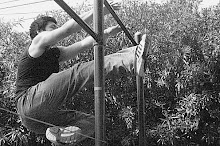
My senior project advances my passion for Parkour. I have been an active traceur in the Seattle area for 2 years (starting October 2006) during which time I have learned the basic aspects of the discipline: how to utilize the basic movements that are used as building blocks of how beginning traceurs overcome obstacles, how to see potential routes should I need to use the movements that I've learned, the basic history of Parkour, and studying the underlying philosophy that serves as a guide to traceurs.
I have also been teaching Parkour for 8 months. I first started sharing my knowledge with fellow PSCS community members, through a class that I offered for the final schedule of the '07-'08 school year. Through teaching I gained a further understanding of the discipline, by explaining how and why traceurs move I had the opportunity to analyze my own body and how I personally learned so much about how to move in an efficient manner. Beginning this summer, I started a teaching apprenticeship at Northwest Crossfit, where I learned how to teach in a more constructive and practical way. The Crossfit classes taught me a specific structure of teaching Parkour that further increased my love for how intricate and elegant Parkour is beneath its spectacular surface.
2.How does this project challenge you? What risks will you take in completing this project? What will be your biggest obstacle and how will you overcome it?
In spite of all my skill, I have much more to gain from Parkour. While I have mastered the basic movements, the essence of Parkour isn't really about that. The movement that is “Parkour” is moving in the most efficient way from one place to another, specific moves that are taught will never be used in the exact same way twice, and are adapted to the present circumstances. This project will challenge me to improvise movements to obstacles that I have never experienced before, and that has been one the greatest obstacles that Parkour has presented to me so far.
Physical fitness will also be a challenge for me. The traceurs that I will be training with and learning from in Europe are among the most advanced in the world. As a result of this, the level of strength, endurance, balance, body control, and courage needed to simply keep up with them is far higher than what I am currently at.
The greatest obstacle that will challenge me during the project will be the logistics of coordinating a trip of this scope, something that I am in no way familiar with. The specific challenges are threefold: obtaining funds sufficient to afford my expenses, making contact with the traceurs that I wish to train with, and making sure that what else I need to complete before the trip happens when it needs to. The cost of the trip will exceed $1200; $800 of which I will need by December 15, the latest date which I will be able to reliably book an affordable airline ticket. I will overcome this obstacle by starting work at a part-time job, building web sites, and asking for support from my family.
The traceurs that I wish to include in my project are the owners of Parkour Generations. As owners of one of the largest Parkour organizations in the world, they are extremely busy people, and convincing them to take significant time out of their packed schedules to participate in my project will be a large challenge. To overcome this, I will e-mail Dan Edwardes of Parkour Generations to ask him to help me with my project and to organize the other owners who are interested. As the first trip I've taken to Europe, not to mention on my own, there are many aspects of this project that I do not know of. Nic and the rest of the staff, as well as Shannon, my grandmother, have been a great resource by offering their experience and knowledge to help me make this trip happen.
To further help me meet these challenges, Nic and I meet once a week and go over the things I should do in the coming week. To add more structure to this, Nic has made a sheet where I write down what I am committing to do during that week, and we review how I did at our next meeting. In order to help ensure I follow through on these list, I will be posting them on my blog and will update individual items as I complete them, as well as making note of what objectives I did not follow through on during the previous week.
3.What resources (skills, knowledge, contacts, materials, money, etc.) do you already have that will be useful in completing the project? What resources will you need? How will you get them?
My knowledge of basic Parkour movements, philosophy, and history is a basic and necessary resource. I have a computer with sufficient software to edit photos and video for my presentation of the project. I also have the ability to obtain free software that will do the tasks I need them to if what I currently have isn't enough.
There are many resources I need. The most significant one is the money to fund this trip, which I outlined above. When I make contact with Parkour Generations, I will need them to help me find good places to train in London, as well as the etiquette around training there (for example: what the attitude of the police is towards traceurs). I will also need interviewees, which I will have when I have a contact at Parkour Generations. My grandmother has agreed to help me with obtaining a passport, which includes researching exactly what I need in terms of identification, as well as sponsoring the passport. She is also looking into where I can find cheap lodging in London. I am currently using a clunky camera, which I can use to document my trip, but if I can I would benefit from having a slimmer one that I can fit into my pocket.
4.What will your final result be? How will you measure and evaluate your results?
My final result will be a short video documenting my trip that shows me training in locations throughout London as well as excerpts of interviews with veteran traceurs, a portfolio of photos of me training in London, and a blog that I will update throughout my trip.
I will measure my results by where I end up doing my senior project. I will evaluate it in this way: the ideal result for my project will be for me to travel to London for the duration of the trip, the next best will be for me to travel to Washington, D.C. to meet, train with, and interview members of The Tribe, the least best will be for me to document my training and progression in Washington and Oregon, and interview traceurs in the area.
5.How will you document your progress in completing this project?
I will maintain a blog (separate from my senior blog) from November 3rd to the student showcase documenting the progression of my project; including the lists of weekly objectives that I will also be posting on my senior blog as well, my thoughts on how the project is going so far, and my daily activities during my trip. I will preserve all e-mails, notes from meetings, and other documentation of my activities leading up to and during my trip. I will keep and organize all photos and video of my project.
6.How will you present your completed project to the community?
I will set up a laptop at the student showcase with my video, photos, and blog available on the machine for viewing.