Interview 2
Willow Brugh
January 6th, 2009
By Kellen Fujimoto
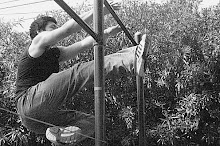
My second credo interview was with Willow Brugh, how I met a little while ago though training Parkour. She is a graduate from Indiana State University, majoring in sociology and getting a minor in religious studies. Her main interests are in Parkour, the advancement of the human race, and technology. She is very passionate about beliefs, as well as society, which led to a very involved discussion that was packed with interesting and insightful information.
1. What are Willow’s core values? What does she believe?
In an e-mail that she sent me after our interview, Willow said that three of her values are integrity, adaptability, and awareness. She’s had these core values her whole life, but didn’t know how to put them into words until she started studying sociology in college. These three values are based on the underlying belief that all people should contribute constructively to society. “All generations operate as if they are the best and the last” she says, meaning that she believes that people should act with the interests of society as a whole at heart. She believes that humans are a community-based species, and that we should all act more in-line with that fact about us.
2. What stories and metaphors did Willow use to illustrate her values and beliefs?
Willow used her experience at the Runcible Spoon in Bloomington, Indiana. She talked about how many people don’t have a consciousness about how they take out their anger and frustration on innocent parties who happen to be in their way. She believes that people should always be civil to one another, and she values additional perspectives on situations. She says that once she joined a law office and saw how everything is streamlined and excellence is required, she could understand why business people expected the same from their restaurants. However, this doesn’t excuse them from being disrespectful, “I forgive the person, not the act,” she says, “I can be cool with a person while not forgiving them for what they’ve done. The past is the past, and time won’t change how I feel about what they did.” She believes that people are constantly changing, which is why she can be accepting of somebody who has wronged her while still holding them accountable for their actions.
3. What are the “hard questions” about the Willow’s values and beliefs? How does she respond to those questions?
It’s not a hard question, per se, but Willow struggles with the idea of people’s personalities not all being equal. She learned that people don’t start out with a standard set of attributes when she was taking sociology classes in college. Intuitively, she believes that nurture, not nature, governs our actions. She also believes strongly in academic knowledge, which tells her that nature and nurture are closely intertwined, and that every person doesn’t get an equal chance.
4. How has your perspective on your own beliefs and values changed as a result of the interview?
My conversation with Willow gave me a new way of looking at my beliefs, my value regarding words being the most pronounced one. She agrees with me that words aren’t the best way of conveying information, but that it’s the best we’ve got. She emphasizes this by saying “conveying ideas is the cornerstone of intelligence. If I have a brilliant idea, but I can’t share that knowledge with you, it’s as if I never had it in the first place.” She also said that it wasn’t the unimportance of words that I meant, but the glorification of words. “We both lead very visceral experiences [when compared with the rest of society],” she points out “people would lead far more balanced and fulfilling lives if they weren’t stuck in their heads.” That hit the nail on the head for me, personally, and I feel that resonate very strongly with me.

No comments:
Post a Comment