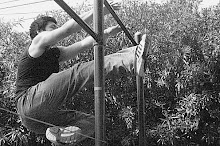
Parkour is often thought of as an entirely physical practice: “jumping over stuff.” However, Parkour is more an exercise of the mind than the body. The most obvious sign that I am a traceur is, of course, how I move. A true practitioner understands that this isn’t the most important part of being a traceur, however. Parkour has an underlying philosophy, a core that gives me an inner strength for any situation I may come across. Incorporating this philosophy into my very being, so that it becomes something as natural as breathing, is what I continue to work towards, what every traceur works towards, as the ultimate achievement in Parkour.
Parkour’s philosophy is often described as “to overcome obstacles as swiftly and efficiently as possible using only the human body.” You actively train for this philosophy through exercise by jumping a gap, vaulting a railing, climbing a wall, etc. Doing so strengthens the body and improves the traceur’s ability to use that specific movement. The result of this isn’t only a conditioned body, however. While training, one of the traceur’s main objectives is to improve their adaptability: being able to see the most efficient path and move through it in the exact way they intended without the need for practicing on that specific obstacle. This is because Parkour is intended to be most useful in an emergency situation when there isn’t time to plan in advance. This ability to think and operate with instinctual creativity is the most ‘practical’ application of Parkour in day-to-day life: innovative, outside-the-box thinking is an essential problem-solving skill especially applicable in this rapidly changing world.
Intent is also very important in Parkour’s philosophy. In order to efficiently move through my environment, I need to focus on my goal of getting to my destination as swiftly and efficiently as possible, even when I’m doing something as simple as training on a railing I need to remember my purpose for training. This is what separates Parkour from child’s play: while the movements look similar, traceurs move in a precise and specific way, whereas playing is free-form and doesn’t purposefully have any goal behind it. I believe that it is important for traceurs to keep this deeper purpose in mind at all times, even when we’re having fun and training with our friends.
Put into practice, Parkour’s philosophy is similar to wu wei, the Taoist principle of acting in accordance with the natural way of things. A common metaphor for wu wei is water: it doesn’t impose itself on anything, and moves with very little effort across great distances. Traceurs who are operating on Parkour’s highest level embody this state of being: seeing and reacting to obstacles without hesitation or conscious thought. This state is called Flow in the Parkour world, where the traceur naturally finds the most efficient path. These moments translate to the mental realm as well, where the goal is to live entirely in the present and let the future take care of itself.
For me, the core of this philosophy boils down to being useful. My body is capable of many extraordinary things, and I believe that my basic responsibility is to ensure that I have the competence to thrive in any circumstance. As a traceur, I recognize that I will have to overcome many challenging obstacles in my life, both mental and physical. I train Parkour to prepare myself for these occasions, as well as to enable me to live in the present and get out of the future’s way.